
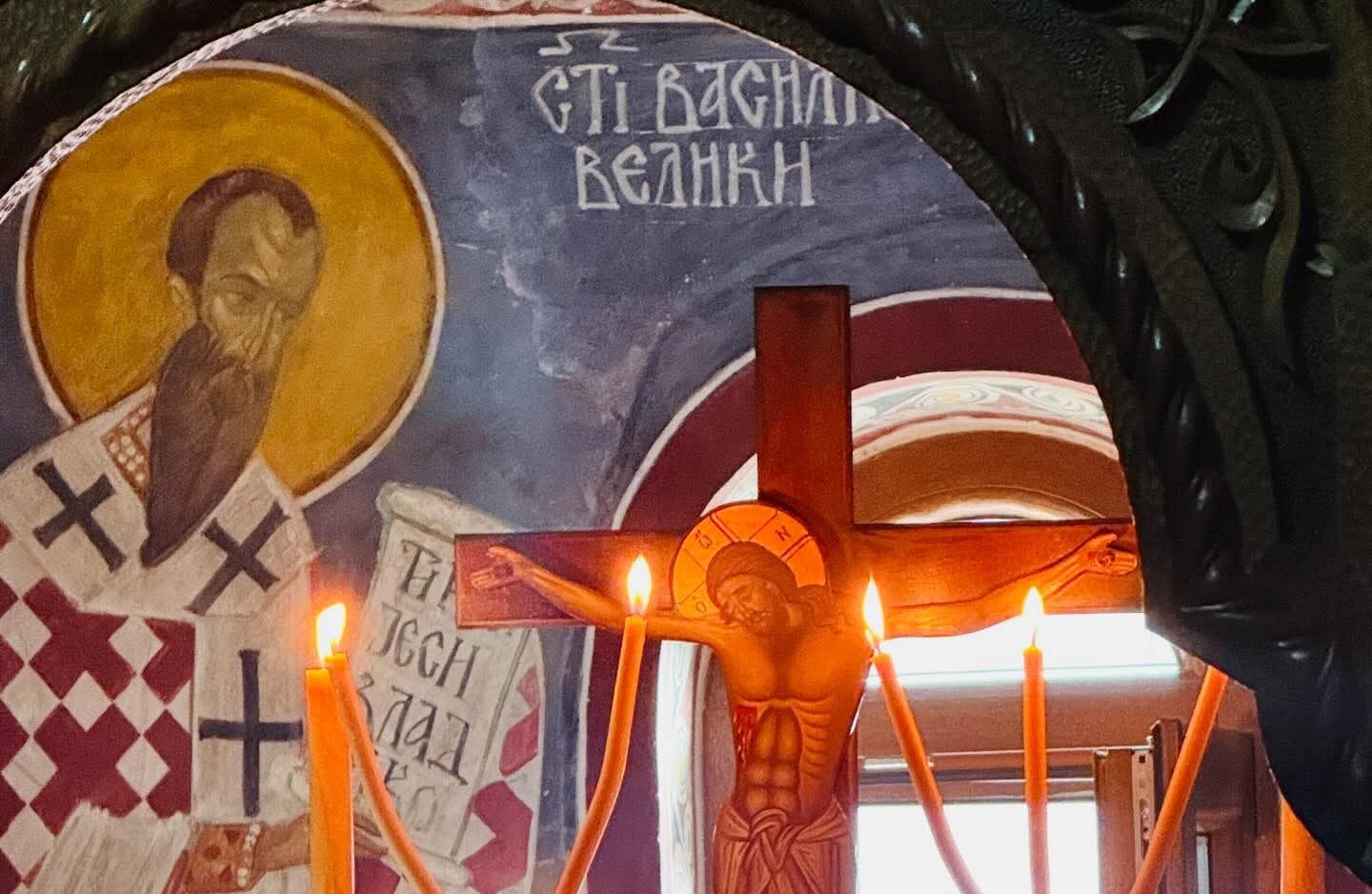
Written by: Catechist Branislav Ilić
The final week of Great Lent preceding the Feast of the Resurrection of Christ is known as Holy Week. Each day of this week is called “Great” due to the momentous events to which we liturgically bear witness and which form the focus of the sacred services. What these sacred events have in common is this: the Lord enters Jerusalem to suffer voluntarily. Saint John Chrysostom testifies the following about Holy Week: “This week is called Great not because its days are longer or because there are more of them, but because the Lord performed great deeds during these days: the kingdom of the devil was overthrown, death was abolished, sin was conquered, the curse was lifted, Paradise was opened, and heaven became accessible to humankind. Humanity was united with the angels, the dividing wall was destroyed and removed, and the God of peace reconciled the heavenly with the earthly. That is why this week is called Great.”
Saint Epiphanius of Cyprus attests that Christians spent the days of Holy Week in particular reverence, in complete fasting and intensified prayer. On the prayerful and silent Monday of Holy Week, we enter the final phase of Great Lent, and through the sacred services, we mysteriously become participants in the Lord’s path of the Cross and suffering. Thus, we mystically partake in His pain, Passion, and Cross, but also in His Resurrection from the dead, as we chant on Paschal night: “Yesterday I was buried with Thee, O Christ my God; today I arise with Thee in Thy Resurrection.”
On Holy and Great Monday, the Church commemorates the righteous and chaste Joseph, the cursing of the barren fig tree, and the Gospel parable of the wicked vinedressers. Great Tuesday is dedicated to the Lord’s dialogue with the Pharisees and Sadducees concerning His Second Coming, as well as to the Gospel parable of the ten wise and ten foolish virgins. On Holy and Great Wednesday, we remember the sinful woman who washed the Saviour’s feet with her tears, dried them with her hair, and anointed them with fragrant oil. On this third day of Holy Week, the Church also reminds us of Judas’s betrayal. The liturgical texts of the day reveal to us the power of repentance and love, for which the grace of God, like oil, abundantly flows upon all who truly repent.
On Holy and Great Thursday, we commemorate Christ’s Mystical Supper at which the Holy Eucharist was instituted. On Great Thursday, we also remember the Lord’s Farewell Discourse, His washing of the disciples’ feet, and His High Priestly prayer before the Passion. On Holy and Great Friday, we liturgically recall the day of the Lord’s suffering. On Holy and Great Saturday, we commemorate the burial of the divine Body and the descent into Hades of our Lord and Saviour Jesus Christ.
The troparion chanted during the first three days of Holy Week awakens spiritual vigilance within us so that we do not fall asleep in the slumber of sin. Thus, already at Matins on Great Monday, in the first kathisma hymn, we chant that the Lord hastens willingly to His Passion: “This day shines with the light of holy sufferings as salvific lamps, for Christ, in His goodness, hastens to suffer. He Who holds all in His hand accepts to be crucified on the tree that He might save humankind.”
In a similar manner, the church hymnographer, in the first sticheron at Lord, I have cried, poetically exalts and depicts the Saviour’s journey along the path of suffering: “The Lord, going voluntarily to His Passion, spoke to the apostles on the way: Behold, we are going up to Jerusalem, and the Son of Man shall be delivered, as it is written of Him. Let us also, therefore, with minds purified, go with Him, be crucified with Him, and die to the pleasures of this life for His sake, that we might also live with Him and hear Him cry: I will no longer go to the earthly Jerusalem to suffer, but I ascend to My Father and your Father, to My God and your God, and I shall lift you up with Me to the Heavenly Jerusalem, to the Kingdom of Heaven.”
The entire hymnography of Great and Holy Week contains the proclamation of the Resurrection, as witnessed by the stichera which, through their content, place each of us—both in thought and in heart—before the Saviour’s Cross, while also foretelling the power and glory of the Resurrection.
On Great and Holy Friday, in the second laudatory sticheron, we chant: “Every part of Thy holy body endured shame for our sake: the head—thorns; the face—spitting; the cheeks—buffeting; the mouth—the taste of gall mingled with vinegar; the ears—blasphemous revilings; the back—scourging; the hand—a reed; the whole body—stretching upon the Cross; the limbs—nails; the side—a spear. O Almighty Saviour, Who didst suffer for us and delivered us from suffering, Who didst descend to us in Thy love for mankind and didst raise us up—have mercy on us!”
During the bringing forth of the Epitaphios (shroud) at the Vespers of Great Friday, the sticheron “Thou who clothest Thyself with light as with a garment” is chanted, exalting in a deeply moving way the voluntary Passion of the Saviour. This hymn describes in detail how the entire creation follows, in awe and wonder, the fearful mystery that unfolds for our salvation.
When the Archangel Gabriel proclaimed the good and joyful tidings to the Virgin Mary that she would bear a Son, he also revealed the truth that the Lord Jesus Christ would save His people from their sins. According to divinely revealed truth, the divine Blood of the Lord Jesus Christ purifies all things. The Blood of the Saviour bears a power that transforms, vivifies, and saves.
On Great and Holy Saturday, in the fifth sticheron at Lord, I have cried, the inspired hymnographer declares:
“Today Hades groans and cries out: It would have been better for me had I not received the One born of Mary, for He came upon me and destroyed my dominion; He shattered the bronze gates; He raised up the souls I had once held. Being God, He resurrected them. Glory to Thy Cross and Resurrection, O Lord!”
Saint Epiphanius of Cyprus writes: “Christ is the sacred Service, He is the Sacrifice, He is the Priest, He is the Altar, He is God, He is Man, He is King, He is the High Priest, He is the sacrificial Sheep, He is the Lamb—He became all things in all for our sake, that life might be born to us in every way.”
In order to redeem and save fallen humanity—and through man, the entire creation—the God-man Jesus Christ suffered on the Cross, bestowing upon us salvation. Saint Gregory Palamas teaches that “in the Cross of the Lord the entire Economy of salvation is revealed.”
The soteriological significance of Christ’s Passion is manifest in the uniquely messianic dignity that the Lord displays through His suffering for the sake of mankind. This truth is beautifully expressed by the Church hymnographer in the words: “The King of eternity, by His suffering, brings to completion the Economy of salvation” (Great and Holy Saturday, sticheron at the Praises).
One of the stichera at Lord, I have cried, chanted on Great and Holy Friday, proclaims through the lips of the inspired hymnographer the profound mystery that took place for the salvation of the human race: “Today there occurs a fearful and most glorious mystery: the Unapproachable is seized; the One Who freed mankind from the curse is bound; He Who examines the hearts and innermost thoughts is unjustly interrogated; He Who shut the abyss is shut within a dungeon; the One before Whom all the heavenly powers tremble stands before Pilate; the creature strikes its Creator with its own hand; He Who judges the living and the dead is condemned to death on a cross; the Destroyer of Hades is sealed in a tomb. Glory to Thee, O Most Merciful Lord, Who willingly endurest all things and deliverest mankind from the curse!”
The liturgical service of Great and Holy Friday already intimates the joy of Christ’s Resurrection, for our Lord has truly risen. One of the most exquisite gems of hymnography bearing witness to this is the sticheron chanted at the Ninth Hour on Great Friday:
“Today He is suspended on the Tree Who suspended the earth upon the waters. He is crowned with a crown of thorns, He Who is the King of angels. He is wrapped in the purple of mockery, He Who wrapped the heavens in clouds. He receives slaps on the face, He Who freed Adam in the Jordan. The Bridegroom of the Church is fastened with nails. The Son of the Virgin is pierced with a spear.
We venerate Thy Passion, O Christ!
We venerate Thy Passion, O Christ!
We venerate Thy Passion, O Christ!
Show us also Thy glorious Resurrection!”
Before and after the Resurrection, people remain equally mortal and powerless, yet following this unprecedented miracle and the empty Tomb of Christ, the human race was given the opportunity to turn its sorrowful and mortal existence in a new direction—towards the harbour of eternal life.
More than twenty centuries separate us from that bright Jerusalem dawn, when the holy myrrh-bearing women beheld the empty tomb. They had come to anoint the lifeless body of their Teacher with fragrant oils, to bathe it with their tears, and to warm the cold stone of the grave with the tenderness of their love—thus demonstrating their faithfulness and devotion.
They had stood even by the Cross of the Crucified Saviour, when all others, save for the Most Holy Theotokos and the holy Apostle John the Theologian, had forsaken Him. Even from afar, they witnessed the final moments of the greatest Teacher. They did not forget Him even in death. For this, they were deemed worthy to become the first witnesses and heralds of the Resurrection, and of the new life in the Risen Lord.
For centuries, the echo of the angel’s gentle rebuke, proclaimed from the stone of the tomb, has resounded, bringing us today the joy of a heavenly hope: “Why do you seek the living among the dead? He is not here, but is risen!” (Luke 24:5–6)