
Written by: Catechist Branislav Ilić
“This is the day which the Lord has made; let us rejoice and be glad in it” (Ps. 117:24). With these words, from ancient Old Testament times, King and Prophet David exultantly proclaims, foreseeing by the Holy Spirit the great day of Christ’s victory over death and our spiritual celebration on account of it. On this great and mysterious Day, all creation is bathed in the light of eternity and, with ineffable joy, sings a song of victory to the Lord who has driven away the darkness of sin and illumined us with the unsetting rays of life. “And the Light shines in the darkness, and the darkness did not comprehend it” (Jn. 1:5)—thus did the Holy Apostle, Evangelist, and Theologian John summarize the essence of divine revelation and our Christian witness, he who, at the time of the Mystical Supper, leaned his head upon the Lord’s breast and absorbed the full power, beauty, and mystery of His life-giving God-manhood.
Marvelling at the wondrous Resurrection from the tomb, the Church hymnographer sings: “O Lord, how You were born of the Most Holy Virgin and how You rose from the tomb, we do not know, yet we glorify You as Saviour and Redeemer.” Celebrating with him the Resurrection of Christ, we too stand in awe before this great mystery and sing: “Christ is risen from the dead! By death He has trampled down death, and upon those in the tombs He has bestowed life!” Like the sons of Israel, who, having crossed the Red Sea, offered thanksgiving and praise to God, so we also, having passed through the sorrow and grief of Great Friday and Great Saturday and having entered into the joy of the Resurrection, offer praise to God and proclaim: “Glory to You, O Lord, our Saviour and Deliverer, for You have delivered us from the power of sin, death, and the devil!”
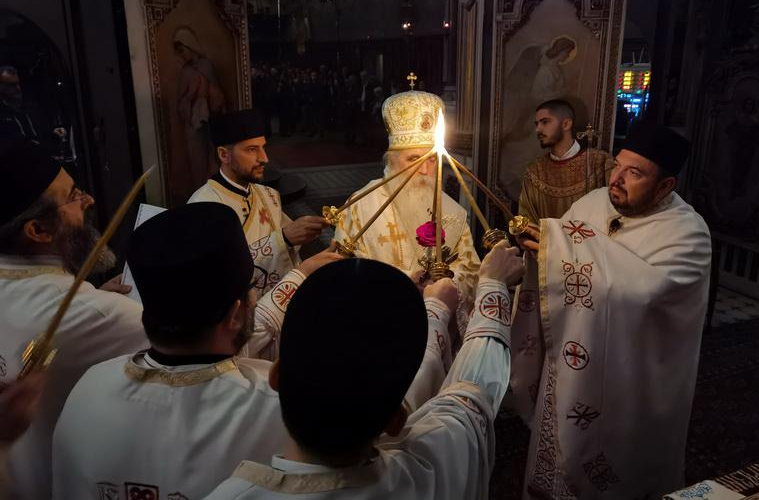
Bright Week is the sacred period from Pascha to Thomas Sunday. The Church’s tradition of celebrating the Feast of feasts—the Resurrection of Christ—throughout the seven days of Bright Week dates back to apostolic times. Bright Week is considered “one day,” since the divine services are celebrated entirely as on the very day of the feast itself. The 66th canon of the Sixth Ecumenical Council states: “From the day of the Holy Resurrection of Christ our God until the New Sunday, the faithful ought to spend their time in zeal, rejoicing in psalms, hymns, and spiritual songs, listening to the teachings of the Divine Scriptures, and partaking of the Holy Eucharist.” During Bright Week, the Psalter is omitted in the services, prostrations are not performed, and fasting on Wednesday and Friday is set aside. Likewise, the use of the Menaion is omitted, the only exception being when the Feast of the Annunciation falls on one of the days of Bright Week.
The services during Bright Week are celebrated with the Royal Doors open. The open altar symbolizes the image of the Lord’s tomb, from which the angel rolled away the stone, as well as the open entrance into the Kingdom of Heaven, which we attain through the redemptive sacrifice and Resurrection of Christ. Throughout the entire Bright Week, festive bell-ringing takes place, and all Christians are permitted to ring the bells at any time. In the spiritual sense, Bright Week is a prefiguration of the age to come and of the unending joy of the General Resurrection in the Kingdom of Heaven, into which we may enter if we here worthily serve Christ our God, both in prayerful hymns and in good deeds towards our neighbors, so that the evangelical words may be fulfilled: “Come, you blessed of My Father, inherit the kingdom prepared for you from the foundation of the world” (Mt. 25:34).
On Bright (Paschal) Monday, at the Divine Liturgy, the reading from the Acts of the Apostles is proclaimed (Acts, pericope 2, I:12–17, 21–26), which describes the election of Matthias among the holy apostles. In addition, the Gospel reading is proclaimed (Jn., pericope 2, I:18–28).
On Bright (Paschal) Tuesday, at the Divine Liturgy, the reading from the Acts of the Apostles is proclaimed (Acts, pericope 4, II:14–21), which contains the sermon of the Apostle Peter before the eleven. In addition, the Gospel reading is proclaimed (Lk., pericope 113, XXIV:12–35) concerning the encounter of the Risen Christ with the apostles Luke and Cleopas on the road to Emmaus. The account of the disciples who, on the very day when Jesus suffered on the Cross, met the Risen Christ on the road from Jerusalem to Emmaus is found only in the Gospel according to Luke (Lk. 24:13–35). A brief excerpt of this account is also found in the Gospel according to Mark: “After that He appeared in another form to two of them as they walked and went into the country. And they went and told it to the rest, but they did not believe them either” (Mk. 16:12–13).
On Bright (Paschal) Wednesday, at the Divine Liturgy, the reading from the Acts of the Apostles is proclaimed (Acts, pericope 5, 2:26–36), which contains the sermon of the Apostle Peter on the Resurrection. In addition, the Gospel reading is proclaimed (Jn., pericope 4, 1:35–51) concerning the encounter of the Risen Christ with Philip and Nathanael. Two of John’s disciples recognize in these words the Messiah about whom they had surely heard many times in John’s sermons. There is no doubt that John had prepared them for this encounter. Now Christ is there, passing by them. They will not miss this opportunity. They go to meet Him. When Christ noticed them, He asked: “What do you seek?” and they answered, “Teacher, where do You dwell?” They do not want Christ in passing, they do not want Him to be merely “along the way.” They desire to follow Him, to learn from Him.
On Bright (Paschal) Thursday, at the Divine Liturgy, the reading from the Acts of the Apostles is proclaimed (Acts, pericope 6, II:38–43), which contains the sermon of the Apostle Peter on repentance. In addition, the Gospel reading is proclaimed (Jn., pericope 8, III:1–15) concerning the encounter of Christ with Nicodemus. Christ’s conversation with Nicodemus is one of the most well-known passages of the New Testament (Jn. 3:1–15). Through the use of particularly powerful associations and motifs, this dialogue—recorded only by the Evangelist John—introduces profoundly significant themes, skillfully integrated into the literary and theological context of the Gospel.
On Bright (Paschal) Friday, at the Divine Liturgy, the reading from the Acts of the Apostles is proclaimed (Acts, pericope 7, III:1–8), which recounts the miracle performed by the Apostle Peter in healing the lame man. In addition, the Gospel reading is proclaimed (Jn., pericope 7, II:12–22) concerning Christ’s expulsion of the merchants from the Temple in Jerusalem. This Gospel episode shows that the Lord is present in the Temple as one who has authority, as the true Teacher. The Feast of the Most Holy Theotokos of the Life-giving Spring (Ζωοδόχος Πηγή) is celebrated on Bright Friday (the Friday of Bright Week). It should be noted that the epithet “life-giving spring” does not refer to a geographical direction, but to a source, a fountain. Researchers have not recorded that this service found a place in Serbian Church Slavonic Lenten Triodia, yet it is present in the Pentecostarion (of the Russian recension), which is used in our Church today. In the title of the Synaxarion it is emphasized that this feast is dedicated to “the Most Holy Lady Theotokos, the Life-giving Spring.” It is further noted that on this day the renewal of the church of the Theotokos called the Life-giving Spring is celebrated, and the remembrance of the miracles that occurred there is made. The Synaxarion also contains information about the founding of the sanctuary and the emperors who restored it, most often in gratitude for healing.
On Bright (Paschal) Saturday, at the Divine Liturgy, the reading from the Acts of the Apostles is proclaimed (Acts, pericope 8, III:11–16), which contains the sermon of the Apostle Peter delivered in Solomon’s Portico. In addition, the Gospel reading is proclaimed (Jn., pericope 11, III:22–33) concerning the preaching of Saint John the Prophet, the Forerunner and Baptist of the Lord. After celebrating the first Passover, Jesus Christ went to the Jordan, where He remained for some time, performing baptisms—not personally, but through His disciples—of those who came to Him. At the same time, John the Forerunner also continued to baptize, but as can be seen from the subsequent words of the Baptist’s disciples, the majority went to Jesus. This circumstance aroused envy in the hearts of the disciples and admirers of the austere prophet. This envious feeling even led them into a dispute concerning which baptism was more effective, greater—Jesus’ or John’s—namely, which one cleanses from sins. As a result of this dispute, the disciples of the Baptist turned to him directly. Wishing to convey to their teacher their envy and resentment toward Jesus, John’s disciples came to him and said: “Rabbi! He who was with you across the Jordan, to whom you bore witness—behold, He baptizes, and all are going to Him.”
The Feast of the Resurrection of our Lord Jesus Christ is the most important celebration in the Church, because Christ’s Resurrection signifies the beginning of the resurrection of all humanity and represents the final victory of life over death. For this reason, the Orthodox Confession, or the Symbol of Faith, concludes with the words: “I await the resurrection of the dead and the life of the age to come.” The Resurrection of Christ does not signify a return to earthly human life, which is characterized by suffering and the fear of death; rather, it signifies the passage of human beings into another life—the eternal heavenly life. Therefore, on the Paschal night, the Orthodox Church sings: “Today we celebrate the death of death and the beginning of eternal life.”
Upon the truth of the Risen Christ, who appeared to the Myrrh-bearing women, to the apostles, and to others, we stand and have our being! The Risen Lord Jesus Christ is the unshakable Foundation not only of our faith and of our Church, but also of our entire existence and of all that is. “If Christ has not been raised, then our faith is in vain, our hope is in vain, and we are still in sin!” says the holy Apostle Paul. In the Resurrection lies the meaning of all that exists, and without the Resurrection everything—even life itself—is meaningless. In the Resurrection of the Lord Jesus Christ is revealed the mystery of the Incarnation of God the Logos, that is, His birth in Bethlehem and His suffering as the Lamb of God in Jerusalem, as well as everything that has taken place not only in Jerusalem and Judea but in the entire history of the world.