
Written by: Catechist Branislav Ilić, Editor of the “Kinonia” Portal
Life and prayer are utterly inseparable, and this becomes especially evident during the days of Great Lent, when we engage in prayer more fervently than during the rest of the year—a fact reflected in the entire structure of the Church’s liturgical life. Our reflection here is dedicated to the Lenten prayer of Saint Ephraim the Syrian, which, due to its content and spiritual significance, is often referred to as the “Prayer of Lent.” Because of his poetic gifts, Saint Ephraim has been called “the harp of the Holy Spirit.” He was born around the year 306 BC into a Christian family in the Syrian city of Nisibis, though some sources suggest the broader region around that city as his birthplace. Saint Ephraim was spiritually formed under the guidance of the great ascetic and prominent bishop of Nisibis, Saint Jacob (303–338 BC). Let us not forget that fourth-century Syria possessed a deeply cultivated spiritual life. As a divinely inspired hymnographer, Saint Ephraim marked an entire epoch in the history of Syriac ecclesiastical literature and Orthodox spirituality as a whole. According to his hagiography, he declined both priestly and episcopal ordination, remaining a deacon until the end of his life. He composed nearly four hundred hymns, most notably on repentance. The power of repentance is most concretely expressed in his Lenten prayer, which is the subject of our present reflection. This wondrous servant of God reposed most likely in the year 373 BC.
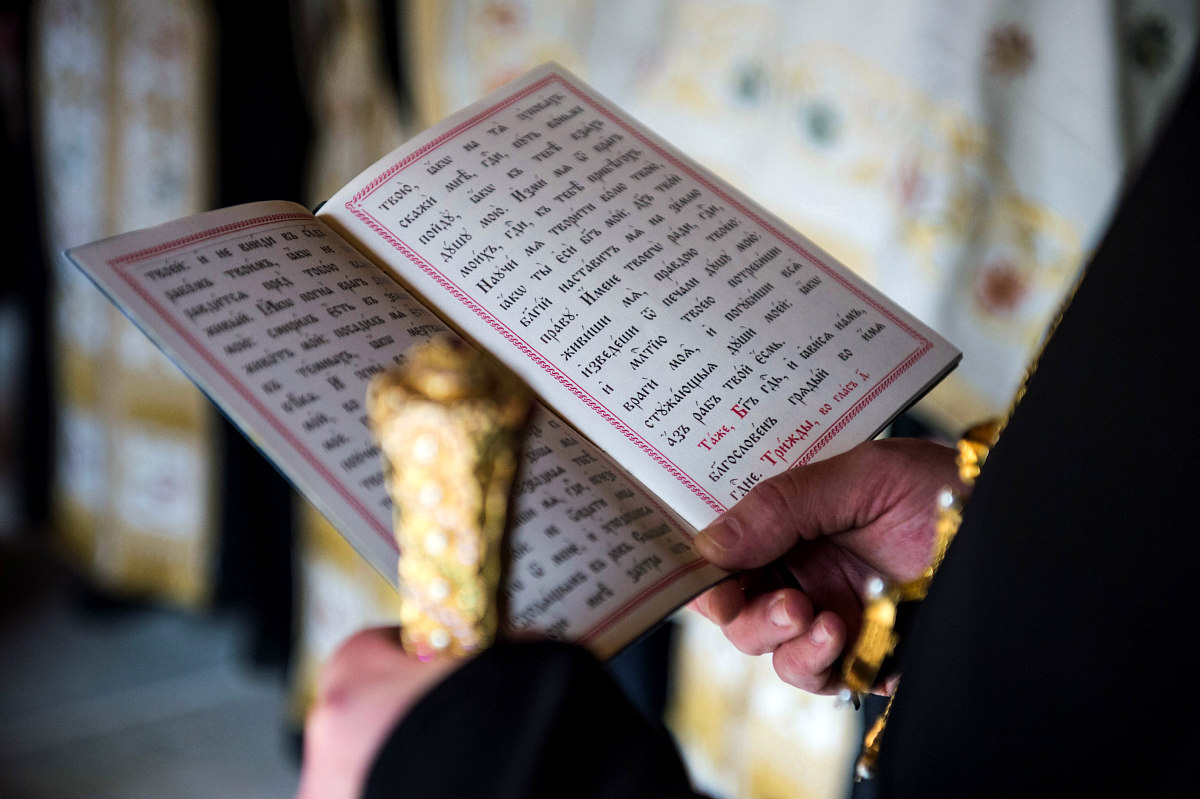
The Lenten Prayer of Saint Ephraim the Syrian:
O Lord and Master of my life, take from me the spirit of sloth, despair, lust of power, and idle talk.
But give rather the spirit of chastity, humility, patience, and love to Thy servant.
Yes, O Lord and King, grant me to see my own transgressions and not to judge my brother and sister, for blessed art Thou unto ages of ages. Amen.
Throughout the liturgical year, the prayer of Saint Ephraim the Syrian is recited exclusively during Great Lent—the Holy Forty Days. Its liturgical use begins on Tuesday and Thursday of Cheesefare Week. This prayer is recited twice at the end of every service from Monday through Friday, excluding Saturdays and Sundays. On Sunday evenings, the prayer resumes at Vespers. The final time it is said is during the morning service of Holy Wednesday.
The recitation of the Lenten prayer is accompanied by full prostrations, which bears witness to our participation with our entire being in the process of repentance and metanoia to which the prayer calls us. Saint Ephraim not only implores God to grant him the spirit of virtues and to deliver him from the spirit of the passions, but also prays that not even a trace of the passions remain, and that the soul might become fragrant with Christ. For we humans find it easier to overcome individual sins than to be freed from the very spirit of sin. The Saint thus addresses the essence of our struggle. It is not by chance that the great Dostoevsky declared this prayer to be a “complete catechism of the faith.”
Why does our holy Church assign such a special place to this prayer within the liturgical services of Great Lent, and why is it repeated so often during the Lenten services?
The sacred period of the Great and Holy Forty Days is a time of repentance and complete spiritual renewal. The entire flow of Lenten liturgical services bears a penitential character and is aimed at drawing us into the mystery of repentance. The Great Canon of Saint Andrew of Crete, readings from the Old and New Testaments, the hymns of the Church—all these present to us examples of true repentance and the fruits of genuine spiritual transformation. The prayer of Saint Ephraim the Syrian is called the “Prayer of Lent” for good reason: its content is in perfect harmony with the very purpose and meaning of these Lenten days.
The repetition of this prayer during liturgical services, accompanied by prostrations, serves to awaken us spiritually and reminds us that we are on the Lenten journey—a most fitting time for overcoming sin within ourselves.
In the first part of the prayer, the Saint lists the gravest sinful weaknesses that ensnare a person, diverting them from the true path of salvation onto a path of perdition. Sloth is the first weakness mentioned. Saint Theophan the Recluse says: “Sloth of the soul and the neglect of good deeds lead the soul to ruin and cause it to become overgrown with the weeds of sin. Life is given to us so that we may hasten to perform the great task of purifying our heart by following the Lord Jesus Christ. To follow the Lord is an active endeavor and often a very difficult labour, not idleness.”
Equally destructive is the love of power. For this reason, Saint Ephraim the Syrian also prays in the first part of his prayer: “O Lord and Master of my life, take from me the spirit of lust for power.” It was because of the love of power that the foremost among angels fell from heaven. The Lord said to His disciples, and through them to all of us: “Whoever wants to be first among you must be the servant of all.” The desire for power is the need to rule over others, to place oneself above others, and to control the world according to one’s own will. At the root of this lust for power lies pride. By praying that the Lord may grant us the strength to overcome the desire for power, Saint Ephraim is also praying for the defeat of pride.
The Lord has said that we will give account for every idle word on the day of judgment. Therefore, Saint Ephraim the Syrian prays: “O Lord and Master of my life, take from me the spirit of idle talk.” Nothing is more destructive than idle talk, nor anything more harmful than an unbridled tongue. Saint Philotheos of Sinai teaches: “Idle talk destroys everything that we build in ourselves each day, and everything that we gather with effort, the soul dissipates again through talkativeness.” Saint Ephraim reminds us that every word we speak should be an icon of God’s Word. Scripture teaches that “by your words you will be justified, and by your words you will be condemned” (Matt. 12:37).
In the second part of the prayer, Saint Ephraim prays that the Lord would grant us four of the highest virtues: chastity, humility, patience, and love.
The Greek word “σωφροσύνη” is often translated as “chastity,” which, like the Slavic word “chistota” (purity), might lead us to think of total abstinence. However, the word “σωφροσύνη” means much more, which is why its Slavic translation “tselomudrie” (wholeness of mind) is more accurate. A person without “tselomudrie” loses their integrity. To preserve integrity, one must possess wisdom, and in the term “tselomudrie” this unity of integrity and wisdom is expressed. Saint John Climacus says that “tselomudrie” is a holistic view of the world. A person lacking in “tselomudrie” cannot fully embrace another person or even themselves. Such a person sees fragmentarily, seizing upon a single aspect and absolutizing it.
According to Saint John Chrysostom, humility is the foundation, mother, and beginning of all virtues. Humility is the base and starting point of all Christian virtues. Without it, every spiritual edifice collapses and falls. It is the Christian alphabet of salvation. For Saint John Climacus, humility is the queen of virtues, while “humble-mindedness” is the nameless grace of the soul, known only to those who have encountered it through personal experience. It is an ineffable treasure and a gift from God. Humility is the gateway to the Kingdom, ushering in those who draw near to it, while “humble-mindedness” is the divine shelter that shields us from seeing our own good deeds. Abba Isidore teaches: “Humility is a great height, and pride a great abyss. Therefore, I advise you to love the former, so that you may not fall into the latter.” Thus, true humble-mindedness consists in obedience to Christ and in keeping the same mind that was in Christ Jesus (Phil. 2:5–8).
Speaking about the mystery of patience, Saint Nektarios of Aegina teaches: “Patience is a moral strength that calms sorrowful emotions awakened in the human heart and eases pain in adversity. Patience is a virtue, the fruit of hope in God. Suffering produces patience, patience produces experience, experience produces hope, and hope does not disappoint. Patience is the first among virtues, for it, as hope, brings salvation. He who endures to the end shall be saved. In patience lies the salvation of our souls.” Throughout the history of salvation, patience has become the foundational virtue of the Church, her power and strength that triumphs across space and time. Patience is the very being of prophets, the righteous, martyrs, confessors, monks, and every person filled with faith. Patience is the visible power of the Holy Spirit, Who transforms all things and makes them new, immortal, and Godlike. In patience amid the senseless forces, the imminent power of the Resurrection is always revealed in the conditions and limitations of the world, tearing apart the chains and bonds of sin and death.
In the 33rd chapter of the Hilandar Typikon, regarding the virtue of love, the following is written: “Nothing is greater than love, for love is the glory and perfection of all virtues. All other virtues and human deeds are like the members of the spiritual man, and love is the head and the union of the whole man. Along with love are united lofty humility, mercy, and philanthropy, for which God became Man.” To love another human being, one must have a kind heart. There is a simple way for a person to discern whether they are capable of loving others, and whether love for one’s neighbour can become part of their life. Anyone can answer this question: if the heart does not respond to another person’s pain, if one cannot feel compassion for another (not necessarily a close relative, but one whom we refer to in church life as a neighbour), then it is not possible to love one’s neighbour. Figuratively speaking, no love can grow on soil fertilized with malice. That is not nourishing fertilizer but poison that kills the human soul. Therefore, Saint Ephraim prays that the God Who is Love may grant us the readiness to love in accordance with the Gospel so that the true seed of love may be enthroned in our hearts. It is of no use to us to be freed from the spirit of vice and to acquire all virtues if there is no love in our heart and soul.
In the third and final part of his prayer, Saint Ephraim the Syrian prays that the Lord would grant us spiritual vision and the ability to see our own sins and not to judge our brothers and sisters.
Saint Luke of Crimea writes: “There is a sin in our eye as large as a beam, yet we do not notice it, but only see the speck in our brother’s eye. Do you remember how the Lord was brought a woman caught in adultery and how He said: He who is without sin among you, let him throw a stone at her first.” The time of Great Lent is given to us so that we may perceive our sins more deeply and sincerely repent for them. Without God’s help, people are incapable of rightly perceiving their sins, which is why Saint Ephraim prays that the Lord would grant us the gift of recognizing our sins.
Judging others is an unhealthy spiritual state. One who remains in it must endure great suffering and anguish of soul—in fact, they already experience a foretaste of hell before the Last Judgment. Even the greatest of our sacrifices will not be accepted by God if we judge our brother. If someone were to renounce the whole world and all its goods for the love of Christ, and withdraw to the deepest desert and close themselves in the most remote and desolate cell, yet still judge their brother, it is all in vain. The person who concerns themselves only with their own sins is wise, and the Holy Spirit dwells in them—they possess peace of heart. On the other hand, the soul of one who judges others resembles a stormy sea. That is why Saint Ephraim crowns his Lenten prayer with a petition that the Lord would preserve us from the weakness and sin of judging others.
Following the content of the prayer of Saint Ephraim the Syrian, our inner being beats with the rhythm of the Lenten journey. This prayer continually awakens and guides us spiritually; it instructs us to arm ourselves with virtues and cast off sinful weaknesses, thus preparing for the Feast of feasts, when we, renewed in spirit, will proclaim from the depths of our soul at the dawn of Paschal Matins: “Come, receive the light from the Unwaning Light, and glorify Christ Who is risen from the dead!”