
Written by: Catechist Branislav Ilić
“Blessed are You, O Christ our God, who revealed the fishermen as most wise, by sending down upon them the Holy Spirit; through them You drew the world into Your net. O Lover of mankind, glory to You!” (Troparion of the Feast of Pentecost)
The Feast of Holy Pentecost is founded upon the eponymous Old Testament festival. On the fiftieth day after the Jewish Passover, the Old Covenant celebrated the “Feast of Weeks”—so named because it fell in the seventh week following Passover. It marked the beginning of the wheat harvest. In the Synaxarion of Holy Pentecost, it is written: “We received this feast from the Jewish Scriptures. Just as the Jews celebrated their Pentecost because they venerated the number seven and received the Law fifty days after Passover, so too do we, after the Passover, celebrate fifty days and receive the Holy Spirit, the Giver of the Law, who leads us on the path of all truth and commands what is pleasing to God.”
In the Old Testament, the Holy Spirit forms the Old Covenant Church as Israel, the chosen people gathered around the patriarchs, kings, and prophets. If Pascha is the crown and fulfillment of the spiritual prefigurations of the Old Testament Passover—where the blood of the Lamb delivers from death and leads from bondage to freedom—then Pentecost (also known as Trinity Sunday or the Day of the Holy Spirit) is the realisation and fulfilment of the assembly at Sinai on the fiftieth day after the Exodus from Egyptian slavery. The Holy Spirit gathers the Christians into the Church, the New Israel. The descent of the Holy Spirit on the day of Pentecost is the visible revelation of the New Testament Church, which lives and exists by the Holy Spirit. Though the Holy Spirit did not become incarnate like the eternal Son of God, He is ever-active, ever-present, and inspires all. The descent of the Holy Spirit upon the apostles is a sacred event that occurred once in history, yet is continually repeated at every Divine Liturgy. Thus, by its very nature, the Church is a perpetual Pentecost. Wherever the Divine Liturgy is celebrated, there the actualisation of Pentecost takes place. The Liturgy, as the assembly of the many, is the revelation of the great mystery of God’s plan for the salvation of the world on the last day—and also the presence of the future Kingdom of God, here and now, in history. The Holy Spirit bestows diverse gifts that manifest in various ways. Saint Paul speaks of the unity of the gifts of the Holy Spirit in his First Epistle to the Corinthians: “There are diversities of gifts, but the same Spirit” (1 Cor. 12:4).
The earliest testimonies of the liturgical celebration of Pentecost date from the 7th century and can be found in the Jerusalem Itinerary. A particular element of the liturgical observance are the processions (lity), which are also mentioned by Egeria in her Itinerarium. Already by the 8th and 9th centuries, we find clearer attestations of the liturgical features of Pentecost, including a rich body of festal hymnography. The hymnography of this feast may be described as a precious treasury of the Church’s teaching on the Holy Spirit.
The first sticheron at Lord, I have cried reveals the essence of the feast’s celebration: “Today we celebrate Pentecost and the coming of the Spirit, and the time of the promise and fulfillment of hope. How great and honourable is the mystery! Therefore, we cry aloud to You: O Creator of all, O Lord, glory to You!”
In the third sticheron, the sacred poet highlights the gifts the Holy Spirit pours out upon His Church, thereby establishing and strengthening her: “The Holy Spirit grants all things: He pours forth prophecies, ordains priests, teaches the unlearned wisdom, makes fishermen into theologians, and establishes the Church’s order. O Comforter, who shares the same essence and throne with the Father and the Son, glory to You!”
In these festal stichera we find profound theology concerning the Holy Spirit, along with insight into the mystery of the feast itself. Moreover, nearly all hymns composing the service of Holy Pentecost are marked by a deep interplay between the Old and New Testaments. More precisely, the hymnography presents an unmistakable witness to the Old Testament Pentecost as a prefiguration of its New Testament fulfilment. In certain stichera, it is especially emphasized that in the event of Holy Pentecost, the Church is constituted as the Body of Christ. All liturgical hymns that make up the service of this feast render present this sacred event of the Economy of our salvation, making us active participants in it. By way of example, let us cite a portion of one of the festal stichera chanted at the Pentecost Vespers (Glory… now and ever at the stichera on “Lord, I have cried”):
“Long ago, languages were confused because of the arrogant building of the tower; but today, tongues speak wisely for the glory of the knowledge of God. There, God condemned the impious for their sin, but here, Christ enlightened the fishermen by the Spirit. There, disharmony arose as punishment, but here, concord is restored for the salvation of our souls.”
To this we add the fourth sticheron at Lord, I have cried, which is also chanted at every Divine Liturgy as a well-known ecclesiastical hymn:
“We have seen the true Light, we have received the heavenly Spirit, we have found the true faith: worshipping the undivided Trinity, for It has saved us.”
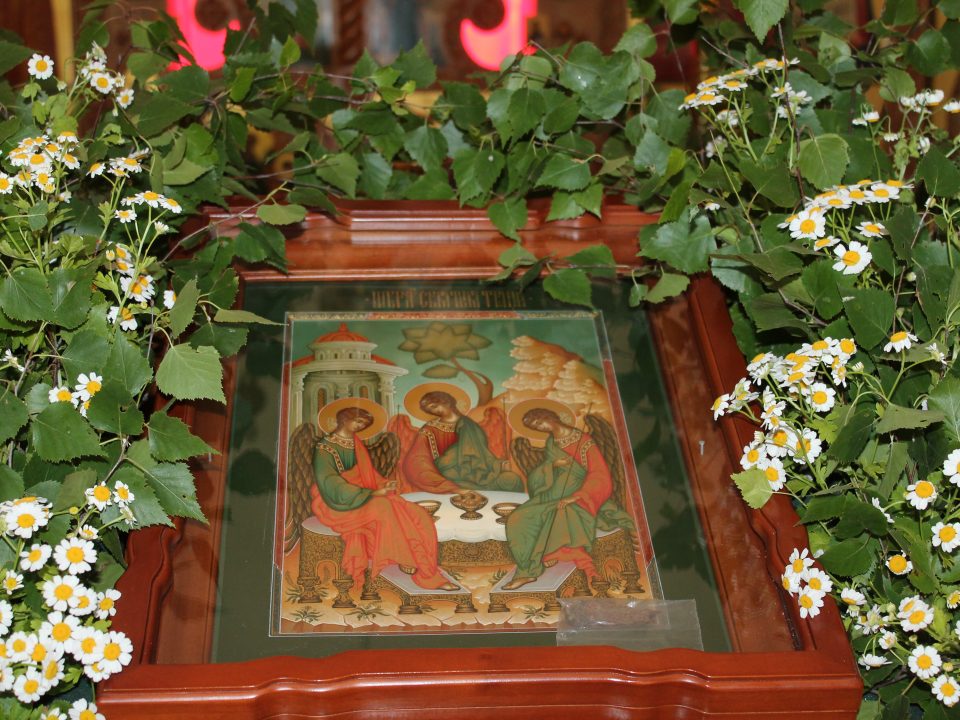
One of the special liturgical characteristics of Pentecost is the Vespers of Holy Pentecost. During this Vespers, six special petitions are added to the Great Litany. After the evening entrance and the chanting of the Great Prokeimenon, three prayers are read, characterised by a tone of thanksgiving and supplication. These prayers glorify God’s love for us and express our plea to remain in that love. They include petitions for all our needs—both for the living members of the Church, upon whom a blessing is invoked, and for the departed members of the Church, for whose repose we pray to the Lord and our Resurrection. These prayers, which are offered only at the Vespers of Pentecost, represent our heartfelt appeal to the Heavenly Father to preserve us under His divine protection. During the reading of these prayers, the faithful in the temple weave wreaths from grass, which carry their own symbolism. The wreath is an image of divine grace descending from above; it is also a symbol of the crown of martyrdom, a seal of God’s gift and support, and an expression of God’s perfection woven into all creation. According to the liturgical order, the liturgical vestments of the clergy are green, and the holy space of the church is adorned with greenery. Thus, the colour green predominates—not only as a symbol, but also as a lesson—reminding us that greenery is the symbol of life, and on the Feast of Pentecost, we celebrate not merely biological life, but eternal life, which is granted to us by the Saviour of the world.
In the Vespers stichera at the stichera on the Aposticha, the church poet expresses the soul’s rapture upon being filled with the grace of the Holy Spirit—the same Pentecostal grace that was abundantly poured out upon the apostles on the day of Pentecost. At the very conclusion of the festal Vespers, the renowned sticheron of Leo the Wise is chanted. It proclaims:
“Come, O peoples, let us worship the tri-hypostatic Godhead: the Son in the Father, with the Holy Spirit. For the Father timelessly begot the Son, who is co-eternal and sits upon the same throne. And the Holy Spirit was in the Father, glorified with the Son. One power, one essence, one divinity—we worship and proclaim: Holy God, who through the Son created all things by the operation of the Holy Spirit; Holy Mighty, through whom we came to know the Father, and the Holy Spirit came into the world; Holy Immortal, Comforting Spirit, who proceeds from the Father and rests in the Son: O Holy Trinity, glory to You!” (Glory and now… on the Aposticha).
*This text was published in the journal Vineyard of the Lord (Pentecost Issue, 2024), pp. 6–8.